Bedding • Practical guide
How Adjustable Beds Change Pillow and Sheet Choices
An adjustable base turns a mattress from a fixed plane into a moving surface. That shift can change where a pillow supports the neck, how a fitted sheet grips the corners, and whether bedding stays smooth when the head or feet rise. The right choices begin not with a luxury label or a thread-count number, but with the way the bed moves—and the way you sleep on it.
A bed that moves changes the small things
Adjustable beds are often chosen for flexibility: a raised head for reading, a lifted foot section for a different resting position, or a flatter setting for sleep. But motion has a practical consequence. As the mattress bends, bedding must bend with it. A pillow that feels supportive when the bed is flat may seem too tall once the upper body is elevated. A fitted sheet that appears secure at bedtime may pull at a corner when the base changes angle.
These are not reasons to make bedding complicated. They are reasons to evaluate it as part of a system. Mattress dimensions, mattress depth, the base’s range of movement, the sleeper’s position, and the frequency of adjustment all matter. A comfortable setup is usually the product of a few deliberate choices rather than a complete bedding overhaul.
The guiding principle is simple: choose a pillow for the head-and-neck position you actually use, and choose sheets that can accommodate both the mattress and its movement. A base may do the adjusting, but the textiles still have to stay in place.
Why elevation affects pillow support
When the head section rises, the body’s relationship to the pillow changes. The upper torso is no longer resting in the same alignment as it does on a flat mattress. Depending on the angle, the head may settle farther into the pillow, shift toward its edge, or feel pushed forward by a pillow that was already tall. The result can be a sense of crowding or a loss of comfortable neck support.
There is no single ideal pillow height for every adjustable bed. The appropriate loft depends on the sleeper’s posture, shoulder width, mattress feel, pillow fill, and chosen elevation. Side sleepers generally need enough height to fill the space between the shoulder and head; back sleepers often prefer a lower profile that does not push the chin toward the chest. Stomach sleepers typically need less loft, though individual comfort varies. Raising the bed can alter those familiar relationships, so a pillow should be judged in the position where it will be used.
Try the pillow at the angle you use most often, rather than evaluating it only while the bed is flat. Let the mattress settle, rest in your usual position, and notice whether your head feels level and your neck relaxed. If you frequently change elevation, test more than one setting. A pillow that works in a gentle incline may not feel the same at a steeper angle.
Pay attention to movement, too. If your head slides down the pillow as the bed rises, its shape, cover, or surface friction may not suit the setup. If the pillow shifts toward the headboard, a pillow with a more stable outline—or a different placement—may help. Small adjustments to position can be more useful than immediately replacing the pillow.
Pillow shape and fill: a matter of response
Different fills respond differently when weight shifts. A resilient pillow tends to push back and retain its outline; a softer, compressible fill may settle more deeply beneath the head. Shredded fill can often be redistributed, while a solid core usually has a more defined shape. None is automatically best for an adjustable base. The useful question is whether the pillow keeps the head comfortable as the angle changes, without requiring constant repositioning.
For sleepers who like to fine-tune loft, an adjustable-fill design may offer room to remove or add material. That flexibility can be helpful when a raised position feels different from a flat one. A contoured pillow may provide a more structured resting area, but its shape should match the user’s habitual posture and feel comfortable at the preferred incline. A pillow designed for side sleeping, for instance, may have a pronounced profile that some sleepers find too high when their torso is elevated.
Material also affects care and handling. Latex, foam, wool, and down or down-alternative fills have different resilience, weight, ventilation, and maintenance needs. Follow the maker’s care instructions: some pillow cores should not be washed or exposed to direct sunlight, even when a removable cover can be laundered. A washable pillow protector is a practical layer, provided it does not make the pillow feel stiff or change its loft substantially.
To assess pillow support, check more than softness. Consider whether the pillow stays under the head, whether the neck feels comfortably supported, and whether the surface becomes too warm. If there is persistent pain, numbness, or discomfort, bedding adjustments are not a substitute for advice from a qualified health professional.
Fitted sheets have a more demanding job
A fitted sheet is made to hold the mattress, but an adjustable base asks it to do more: remain anchored while the mattress changes shape. When the head or foot section rises, fabric can draw toward the bend. If the sheet has little spare depth, weak elastic, or a fit that is already tight, the corners may lift or the surface may wrinkle. A sheet that is excessively loose can also bunch, making the sleep surface feel untidy and potentially uncomfortable.
Start by measuring the mattress itself. Record its width, length, and depth, including any permanent pillow-top or built-in cushioning. If a mattress protector or pad adds height, include that layer when considering the total depth the fitted sheet needs to cover. Do not assume that a size name alone guarantees a correct fit: two mattresses marked “queen” may differ in height, while adjustable-base mattresses may have construction details that affect how the sheet sits.
Look for a fitted sheet with enough pocket depth to cover the mattress and any compatible topper or pad, but not so much that it hangs loosely. A well-placed elastic edge should hold the corners without being stretched to its limit. Some sheets use elastic around the full perimeter; others use elastic only at the corners. Either construction can work, but the real test is whether the sheet stays secure through the base’s ordinary range of motion.
If a sheet slips, check the installation before deciding it is a fabric problem. Confirm that each corner is fully seated, that the sheet is oriented correctly, and that the mattress is not being confused with the dimensions of a thicker pad. Then raise and lower the base slowly while observing the corners and the fabric at the hinge points. A small adjustment in fit can reveal where tension is building.
Elastic, fabric, and the question of friction
Elastic quality and sheet construction often matter more than a fashionable finish. The elastic needs enough recovery to grip after being stretched over the mattress, while the fabric must have enough ease to move with the bed. A very tight fit may look immaculate on a flat mattress but pull sharply when the frame bends. Conversely, generous fabric can create folds if the pocket is far deeper than the mattress requires.
Fabric choice still shapes comfort. Cotton percale is commonly valued for a crisp, breathable hand; sateen usually has a smoother, more fluid feel. Linen has a textured surface and a character that softens with use. Lyocell fabrics can feel smooth and drapey. These differences influence touch and temperature perception, but none guarantees that a sheet will fit an adjustable mattress. Fit is determined by dimensions and construction, not by fiber alone.
Also consider how the fabric behaves in your routine. A sheet that is easy to launder and return to the bed may be more valuable than one with a finish that demands elaborate care. Follow the label’s washing and drying instructions, since excess heat or unsuitable detergents can affect fibers and elastic over time. If a sheet begins to loosen or lose recovery, its fit may change even though the mattress dimensions have not.
Before buying, check the base and mattress manufacturers’ guidance. Some bases have specific recommendations about sheet depth, mattress retainers, or accessories. The base’s design may affect how the mattress flexes, and the mattress maker may set limits on compatible components. Product descriptions should be read carefully, especially when a listing describes a deep pocket but does not specify whether that measurement includes the sheet’s full usable depth.
Pads and protectors add another layer of fit
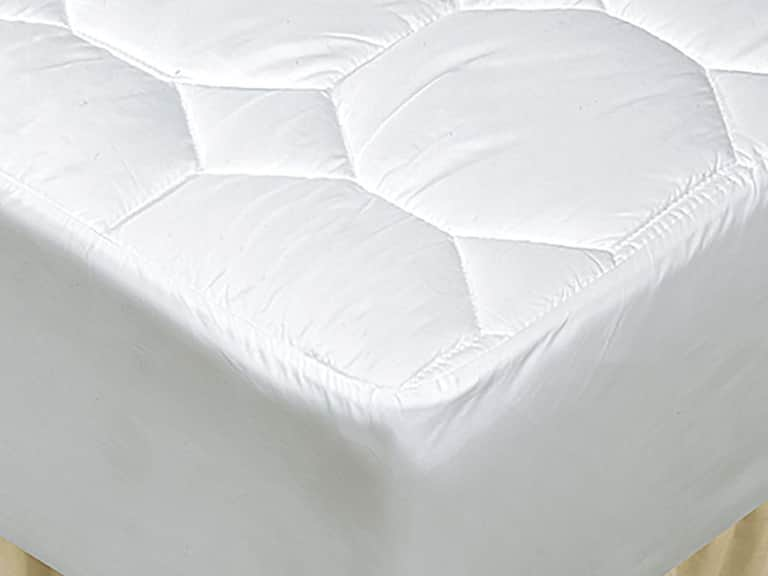
A mattress pad can add cushioning, protect the mattress, and change the total height that a fitted sheet must cover. That makes its own fit part of the adjustable-bed calculation. A pad with a deep pocket or flexible skirt may accommodate a range of mattress profiles, but compatibility with a particular adjustable base should never be assumed from pocket depth alone. Check the pad’s dimensions and the maker’s guidance, and test whether it stays smooth when the mattress bends.
For example, the Downtown Company Luxury Cotton Mattress Pad is described with an 18-inch pocket and a flexible jersey-knit skirt. Those specifications may be useful when comparing a pad’s depth and construction with a mattress setup. They do not, by themselves, establish compatibility with every adjustable base or mattress; verify the measurements and instructions for your own bed before choosing any added layer.
Protectors can affect the feel of the surface as well. A protector that is too taut may restrict the way the mattress flexes, while a loose one can wrinkle or shift. If the base has an articulated mattress, check whether the protector is designed to accommodate its movement. Keeping layers smooth is not merely an aesthetic concern: concentrated folds can become noticeable under a fitted sheet and interfere with a settled, comfortable surface.
Match the bedding to how you use the bed
Someone who raises the head briefly to read may need less specialized bedding than someone who sleeps for hours in an elevated position. A person who changes settings repeatedly through the night may place a higher priority on a sheet that remains anchored and a pillow that does not migrate. The best selection process begins with honest observation: which settings are used, for how long, and in what sleeping positions?
- Frequent head elevation: test pillow loft and stability at the usual incline, and notice whether the head remains comfortably supported.
- Raised foot section: watch for the fitted sheet pulling at the lower corners or fabric gathering around the knees and feet.
- Several positions each night: prioritize secure sheet corners and bedding that can move without repeated readjustment.
- A thick mattress or added pad: measure the complete height before choosing fitted-sheet pocket depth.
- Different preferences between partners: discuss which positions are used most and whether a shared pillow arrangement remains comfortable for both sleepers.
These are practical observations, not a prescription. A particular sleeping position does not dictate one material or brand. Comfort is personal, and the equipment’s instructions should take precedence where compatibility is concerned.
A simple test before settling on a setup
Once the mattress is dressed, test the bed in stages. Begin flat, then raise the head, then the foot, and finally use the combination of settings that is most common. Move slowly, keeping hands clear of mechanical parts. At each position, look for corners that lift, fabric that draws tight, a pad that shifts, or pillow movement that changes support.
Next, lie down in the position you actually use. Notice pressure and alignment rather than trying to judge every detail at once. Does the pillow keep your head in a comfortable position? Does the sheet remain smooth beneath you? Is there a pull at the mattress edge or a fold under your legs? If something feels wrong, change one variable at a time—pillow placement, pillow loft, sheet tension, or the added layer—so you can identify what helps.
Repeat the check after laundering. Sheets can feel different when freshly washed, and elastic performance may change with use and care. If a fitted sheet begins to loosen, confirm that it is not shrinking, stretching, or being fitted over a newly added layer. Keeping a short note of the measurements and settings that work can make later replacement much easier.
Common assumptions worth leaving behind
“A deeper pocket always fits better.” Not necessarily. A pocket should be deep enough for the mattress and layers, but excess fabric may bunch or shift. Accurate measurement is more useful than choosing the deepest option available.
“A firmer pillow is always better for elevation.” Firmness is only one part of support. Height, shape, fill response, and the sleeper’s posture all matter. A firm pillow that is too tall can still feel poorly matched.
“A luxury fabric will stay put.” Fiber quality and fit are separate questions. A fine linen, cotton, or silk textile can feel beautiful and still have unsuitable dimensions or insufficient elastic for a particular setup.
“If the sheet slips, the base must be at fault.” Slippage can result from pocket depth, corner construction, mattress dimensions, added layers, or how the sheet is installed. Check the full combination before assigning the cause.
“Adjustable beds require special sheets in every case.” Some sleepers find that standard fitted sheets work well when correctly sized and secured. Others need a different construction or a more precise fit. The base and mattress guidance, followed by a movement test, provides a better answer than a blanket rule.
A considered approach to better bedding fit
Adjustability changes the conditions of rest, not the basic aim: a supportive pillow, a comfortable surface, and bedding that stays where it belongs. The difference is that every part has to cooperate with motion. A pillow must feel right at the angle where it is used. A fitted sheet must cover the real mattress depth and remain secure when the bed bends. Pads and protectors must add comfort without creating an unstable stack of layers.
Begin with measurements, then test the bed in its everyday positions. Give priority to the sleep posture you actually maintain, not an idealized picture of how you think you should sleep. If the setup works flat but fails when elevated, adjust one component at a time and consult the manufacturers’ instructions. The most successful bedding is not necessarily the most elaborate. It is the bedding that quietly follows the bed’s movement and lets the sleeper forget about it.
Quick checklist
- Measure mattress width, length, and depth, including any permanent cushioning.
- Account for the extra height of compatible pads or protectors.
- Choose fitted-sheet pocket depth and elastic construction for a secure—not strained—fit.
- Test pillow support at the head elevation you use most often.
- Move the base through its usual settings and check for slipping, pulling, or bunching.
- Follow care and compatibility instructions from the mattress, base, and bedding manufacturers.